Say hello to March month. Here’s what’s been happening—and what’s ahead—in our world of conservation.”
In this issue
- What a Wonderful World Book 3
- Our talk on 19 February by Prof Mike Bruton on the Evolution of Creativity
- Can resurrection plants save our crops
- Lukhanyo – Science of flowering plants
- Expo on Fire!
Upcoming Events
Talk on Wildlife Rescue by Michelle Watson| More expos on Fire!| Plant Science with Applewood Primary and Hermanus High Gr 10
What a Wonderful World! Book 3
Our third book in the series of nature stories is progressing well. Margie Crossman has, once again, done some superb illustrations for the book. Of course we will need funding to cover the costs, so we are once more appealing to our members to support this educational publication. We are hoping that our incentives will be persuasive.
For a donation of R500 or more, you will receive a signed copy of the book (author and artist). For any donations of R1,000 or more, you will receive a signed copy of the book plus an illustrated bookmark. A further bonus is that donations over R500 are tax deductible in South Africa.
We are running a crowdfunding campaign on ThundaFund – which will be shared with you in a separate mail. But if you would like to donate directly to WCC, the Bank account for EFT is Nedbank Account no. 1345020716.
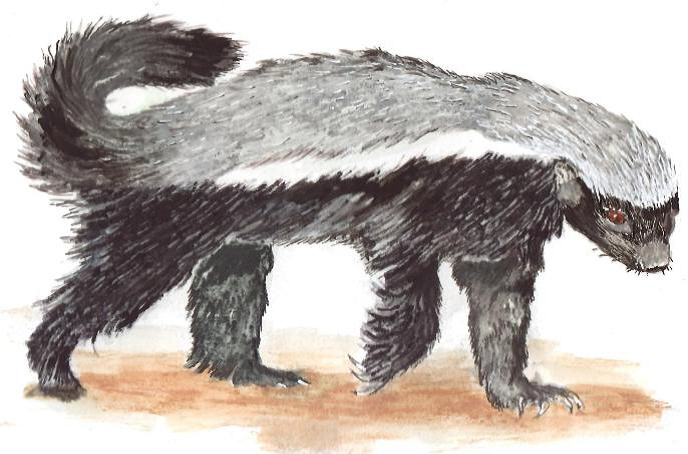
Talk by Prof Mike Bruton
What is intelligence, and how important has it been in the evolution of animals? How and why did the intelligence of early humans in southern Africa lead to them developing language, art, dance and music? Why did early San rock artists not paint the animals that they hunted? Why were the eland, elephant and praying mantis of such symbolic importance to the San?
Find out in this fascinating talk that reviews the latest research on our prehistoric ancestors. To learn the answers to these questions, join us to hear more about this fascinating topic from Prof Mike.
Diarise Thursday 19 March at 17h30 at the GreenHouse.

Feeding the World by 2050: Lessons from Africa’s Resurrection Plants
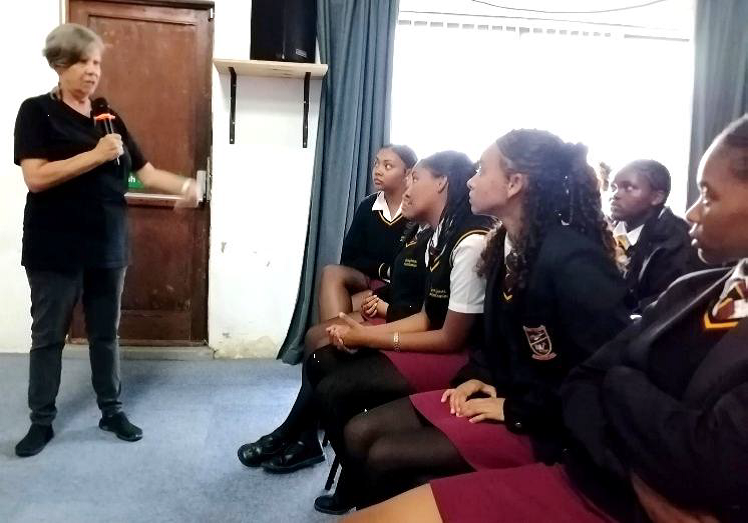
Climate change is no longer a distant forecast. By 2050, drought is projected to be one of the greatest threats to agriculture across Africa and much of the world. Against this sobering backdrop, Professor Jill Farrant’s recent talk offered something both rare and valuable: cautious, evidence-based hope. Her talk was especially appreciated by learners from Gansbaai Academia – who are the next generation dealing with the effects of climate change.
Her work focuses on “resurrection plants” — extraordinary species capable of losing up to 95% of their water and surviving in a dry state for years, only to return to full life within hours of rainfall. Most plants would die after losing even a fraction of that water. Yet these remarkable species, many of them native to Africa, have evolved a way to shut down safely and restart when conditions improve.
Why does this matter? Because global food security is under strain. Staple crops such as maize are vulnerable to prolonged drought. If climate models prove correct, extreme dry periods will become more common and more severe. The key question is whether we can develop crops that behave more like resurrection plants — able to endure severe water stress without dying.
Professor Farrant’s research explores exactly that possibility.
One option lies in biotechnology. Resurrection plants use protective antioxidant genes at unusually high levels. Early research transferred similar genes into maize using genetically modified (GMO) techniques. Field trials of these transgenic maize plants are currently underway. The results show improved drought tolerance, though not the ability to survive extreme, prolonged desiccation. Even so, incremental resilience could make a significant difference in marginal farming regions.
Another approach builds on conventional plant breeding. Over 7,500 years, maize has already been dramatically reshaped from its wild ancestor, teosinte. Careful, targeted breeding — assisted by modern genomic tools — remains a powerful and socially accepted method for improving crop performance.
More recently, gene-editing technologies such as CRISPR-Cas have opened additional possibilities. Rather than introducing foreign genes, CRISPR allows scientists to switch existing genes on or off. In the case of maize, drought-tolerant genes already exist in the seed. The challenge is activating those same protective mechanisms in the leaves, as resurrection plants do. This subtle reprogramming may prove more acceptable than older genetic modification techniques.
A further and promising option lies beneath our feet. Microbial biostimulants — beneficial bacteria, fungi and viruses living around plant roots — can enhance growth and stress tolerance. In trials, microbes associated with resurrection plants have been coated onto maize seeds, producing encouraging results. Expanded field testing is underway.
Even at the molecular level, discoveries continue. Under dry conditions, certain plant molecules combine to form natural deep eutectic compounds — protective substances that stabilise cells during desiccation. Understanding and mimicking such chemistry may provide yet another tool in the agricultural toolkit.
None of these approaches alone will “solve” food insecurity. Drought-tolerant crops may yield less in good years and still struggle in extreme conditions. Development takes time, funding and careful regulation. But taken together — biotechnology, gene editing, conventional breeding, soil microbiology and plant chemistry — they represent a portfolio of solutions.
Africa holds a unique genetic treasure in its resurrection plants. By studying how they survivethe seemingly impossible, scientists are uncovering pathways to crops that can better withstand a hotter, drier future.
Feeding the world by 2050 will require innovation, ethical debate, and global cooperation. But as Professor Farrant’s work shows, nature has already written part of the blueprint.
Plant Science with Lukhanyo Primary
A request came from Mr Nomaya, Natural Sciences Educator at the school, to help their learners to connect their classroom learning about plants to real life.
The Hermanus Botanical Society generously sponsored the workshop at Fernkloof Nature Reserve, which was attended by a total of 55 learners in Grade 7.
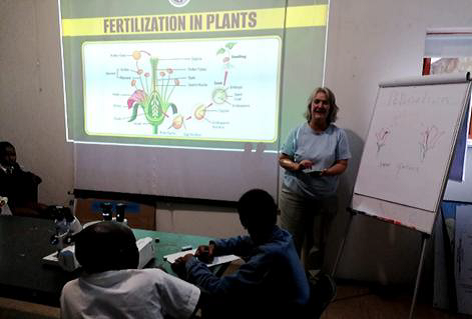
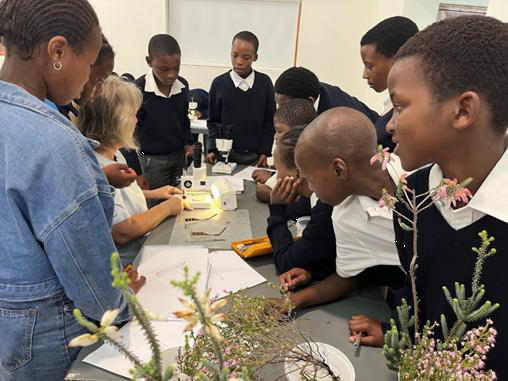
Sheraine van Wyk introduced the learners to the basic structure of flowers. She showed them the male and the female structures and how fertilisation occurs through pollen transfer. She explained why flowers need to be fertilised in order to produce seeds. They used as examples the 4 major plant groups in fynbos: restios (the groups that defines fynbos), proteas. Ericas and geophytes (bulbs). They could try to correlate the flower structures with their pollinators.
The learners could consolidate what they learned in theory by looking at the fine structures of various flowers through microscopes. After the indoor sessions, they had the opportunity to explore the natural fynbos in the Reserve, and tried to identify the major fynbos plant groups as they walked. Both learners and teachers were most appreciative of the brilliant workshop put together by WCC staff and volunteers.
Fire Expos!
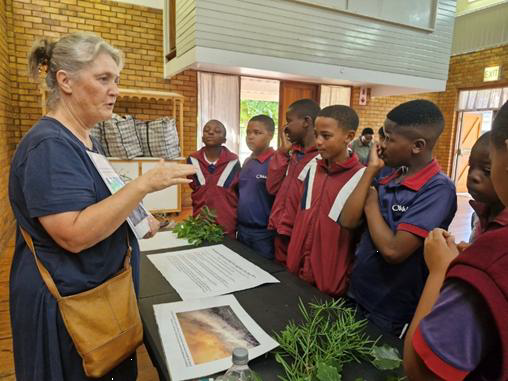
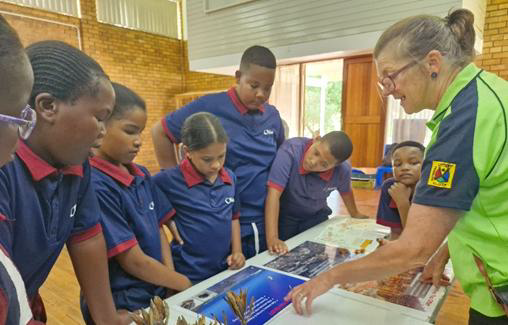
In the wake of the terrifying fires across the Overstrand over the summer especially around Stanford and Gansbaai, WCC took their Expo on Fire to Okkie Smuts Primary – the first of 6 schools. In discussions with the learners, the educators teased out various causes of fires, both the good and the bad of fynbos fires and the way invasive alien vegetation fuels devastating fires. It is imperative that children understand the causes of runaway wildfires, that they understand the negative consequences to both animals and people and that they take responsibility for their actions.
Shirley Mgoboza emphasised the benefits of removing invasive alien invasive plants – to reduce fire risk and restore habitats. They discussedthe reasons for the increased fire damage we now see – including the 30,30,30 rule – over 30 degrees, wind more than 30 km/hr and humidity below 30% = fire. They also explored the reasons why fires jump long distances and how we can safeguard our homes and other structures.
They discussed the role of climate change in more frequent runaway wildfires. Educators also talked about the cost of fires and asked learners how the money could be used more productively if not for firefighting.
Learners discovered that fynbos fires are both good and bad. Fynbos needs periodic fire to regenerate, but wildfires, fuelled by alien vegetation, can wreak destruction. A total of 72 Grade 5 and 6 Okkie learners attended the workshop, which was funded by the AVI Community Trust.
We thank our sponsors